
When organizations work to improve community health, an important question is whether the services and resources available are actually meeting people’s needs. After all, providing everyone with the same opportunities doesn’t necessarily mean everyone can take advantage of them.
That brings us to two terms that frequently come up in conversations about community health: equity and equality.
While closely related, the two concepts have an important distinction. And understanding that difference matters when organizations are trying to meet the needs of the communities they serve.
Equity vs. Equality: What’s the Difference?
Equality means providing everyone with the same resources or opportunities, regardless of their individual circumstances.
Equity recognizes that people face different barriers and may need different types of support to access those same opportunities.
The Robert Wood Johnson Foundation has developed several often-used illustrations to help explain this distinction. The example below offers another way to think about how different types of support can help people access the same opportunities.
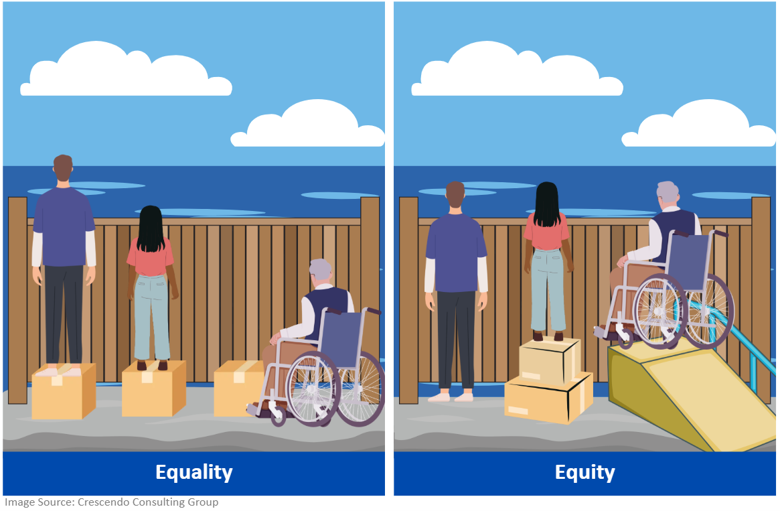
In the image on the left, everyone receives the same box to help them see over the railing. That’s equality. But the same solution doesn’t work equally well for everyone.
In the image on the right, each person receives support that reflects their needs. One person doesn’t need a box at all, another needs additional height, and the person using a wheelchair needs a ramp.
The goal hasn’t changed. The approach has.
What Does Equity Look Like in Community Health?
Consider a community health clinic that offers free preventive screenings to all residents. On paper, everyone has the same opportunity to receive care.
But what if the clinic is only open during traditional business hours? What if residents don’t have reliable transportation? What if information about the screenings is only available in English?
The service may be equally available, but that doesn’t mean it’s equally accessible.
An equity-focused approach might include evening appointments, transportation assistance, or information in multiple languages. These changes don’t necessarily require an entirely new program. Sometimes, they simply require a better understanding of what’s preventing people from using the services that already exist.
Understanding What Communities Actually Need
The distinction between equity vs. equality is particularly important in community needs assessments.
Community-level data can tell us a great deal about access to health care, housing, transportation, and other resources. But averages don’t always capture the full picture. Experiences can vary considerably across neighborhoods, income levels, age groups, and racial or ethnic populations.
And even those categories don’t tell the whole story.
That’s why community engagement is such an important part of the assessment process. Surveys, interviews, and focus groups can help organizations understand the barriers residents encounter and identify opportunities that might not be apparent from the data alone.
At Crescendo, we approach community needs assessments with that distinction in mind. Understanding what resources are available is important. Understanding whether people can realistically access and benefit from those resources is equally important.
Final Thoughts
Communities are made up of people with different experiences, circumstances, and needs. Understanding those differences can help organizations identify where existing services are working well and where barriers may remain.
Ultimately, equity isn’t about assuming what a particular group needs. It’s about asking questions, listening to the answers, and recognizing that the same approach won’t necessarily work for everyone.
And that’s a useful starting point for understanding any community.