
Understanding behavioral health challenges in a community is not always as simple as measuring how many services exist. Behavioral health data can help communities better understand how systems are functioning in practice. For example, what happens when children and families try to move through the system during stressful moments?
A community may have outpatient providers, crisis services, and pediatric behavioral health programs available on paper. But families may still face long wait times, difficulty navigating referrals, limited provider availability, transportation barriers, or challenges staying connected to care after a crisis.
Those experiences do not always show up clearly in high-level statistics.
Why Behavioral Health Data Requires Context
Behavioral health data can help communities better understand how mental health systems are functioning in practice. But numbers alone rarely tell the full story.
The same dataset can point to very different conclusions depending on how the information is interpreted and what local experiences may exist underneath the data.
So what does that look like?
One example is mental health follow-up care data. Follow-up rates can help communities better understand whether children are reconnecting to care after emergency department visits or psychiatric hospitalizations, and how quickly that follow-up is happening.
Data from New York State Medicaid children between August 2024 and July 2025 shows that many children reconnect to care within 30 days after a mental health crisis, but fewer do so within the first week.
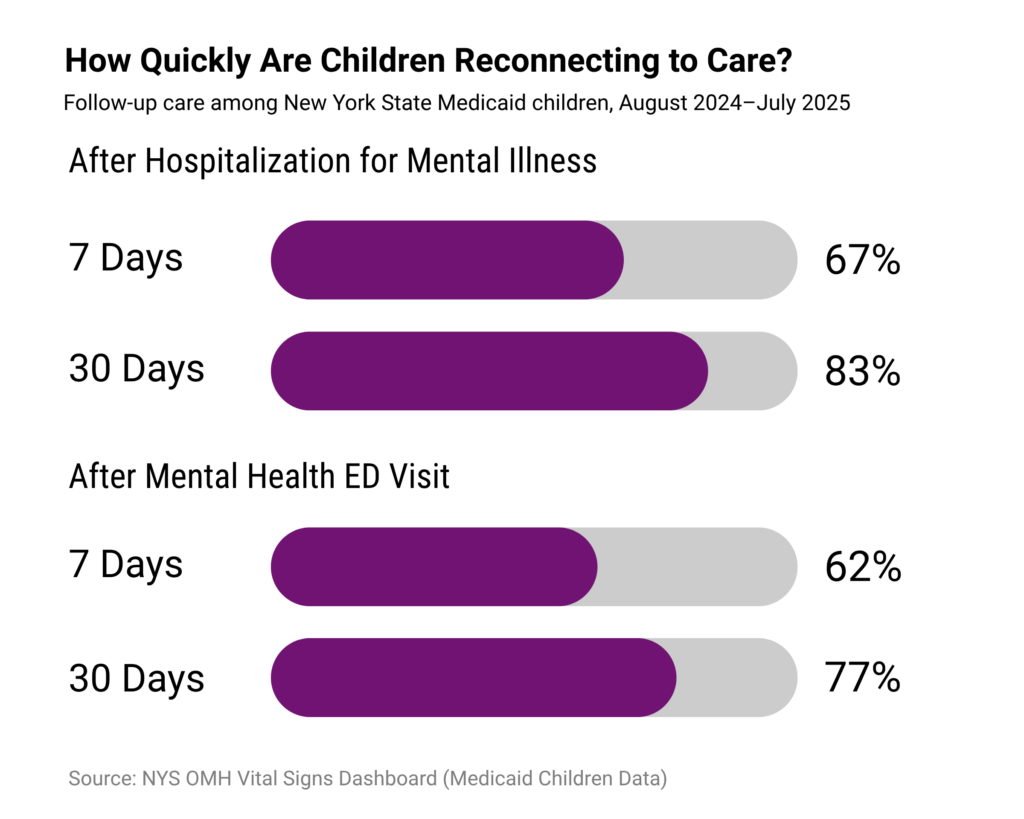
This type of data becomes more meaningful when communities look beyond whether follow-up care eventually occurred and also consider when that follow-up happened.
Looking at differences between follow-up within seven days and follow-up within 30 days can help raise broader questions about how children and families experience the behavioral health system after a crisis.
What Follow-Up Care May Suggest About Community Experiences
Follow-up care data alone does not explain why families reconnect to care more quickly in some situations than others. But it can help communities ask important questions about how behavioral health systems are functioning for children and families after a crisis.
For example, children in this particular community’s dataset had slightly higher follow-up rates after mental health hospitalizations compared to emergency department visits. That difference may reflect stronger discharge planning processes in inpatient settings, different care coordination experiences after ED visits, or other local factors affecting how families connect to ongoing care.
And timing matters.
The days immediately following a mental health crisis may involve coordinating appointments, navigating insurance, arranging transportation, managing school disruptions, or finding providers with availability. In some communities, pediatric behavioral health services may also be limited or difficult to access quickly.
Importantly, one indicator within one dataset cannot explain which factors may be affecting follow-up rates within a specific community. But patterns across behavioral health data can help organizations and community partners better understand where additional questions, community input, or deeper analysis may be useful.
Small differences in behavioral health data can sometimes point to larger questions about how systems are experienced in real-world settings.
Looking Beyond High-Level Behavioral Health Data
This is where community input and qualitative research become important alongside quantitative analysis. Interviews, focus groups, surveys, and stakeholder discussions can help explain why these patterns may exist locally.
In one community, families may describe long waitlists. In another, distance to the closest provider may be the larger issue. Sometimes the challenge is not the availability of services themselves, but how difficult the system feels to navigate during stressful situations.
Often, it is a combination of factors.
Understanding those nuances can help communities move beyond asking whether services technically exist and start asking how behavioral health systems are experienced by the people using them.
That is where behavioral health data becomes more meaningful. Not simply as a collection of statistics, but as a tool for understanding how systems function in practice.
At Crescendo, we support a variety of sectors, including nonprofit organizations, healthcare systems, municipalities, and community partners in interpreting complex population and behavioral health data alongside qualitative research and community input. Together, those approaches can help communities better understand local experiences, identify patterns, and support informed decision-making.
If your organization is trying to better understand behavioral health challenges in the community, learn more about Crescendo’s population health and market research services or our comprehensive community needs assessments.